
Want to learn how to be comedian? Here are 50 time-tested stand-up comedy tips that will help you build a solid career in comedy.
While there are hundreds of comedy tips to choose from, applying these 50 stand-up comedy tips are going to help you learn how to be a comedian. Whether you’re an aspiring comedian with stage fright or you’re getting paid gigs, these comedy tips can still take you to the next level.
Jump to a Section
- Tips For Writing Stand-Up Comedy
- Tips For Performing Stand-Up Comedy
- Tips for Marketing Your Stand-Up Comedy
- Tips For Success In Stand-Up Comedy
STAND-UP COMEDY TIPS FOR WRITING FUNNY JOKES
Here are the best joke writing tips for learning how to be a comedian. These tips will help you find ideas easier and write more confidently.
Pick a Point Of View (POV)
Comedians that don’t have a defined point of view aren’t interesting to audience members. If you’re learning how to be a comedian, developing a strong point of view is one of the first steps to standing out and writing funnier material. When you find the right point of view, writing funny jokes becomes much easier.
Comedians that don’t have a defined point of view aren’t interesting to audience members and struggle to write funny jokes. They’re just talking about “stuff.” Don’t be afraid to find your authentic point of view and stand behind it.
More likely than not, the audience will identify with your crazy reaction to a situation and you’ll end up creating a strong rapport with the audience and getting some huge laughs at the same time. POV isn’t a place where you want to “air on the side of caution.”
If you double down on anything… make it your POV. Learn more about Why Point-Of-View is so important in comedy.
Find the Comedic Conflict
All humor is built off of comedic conflict. Whether the laugh is coming from a comedian, a movie, or even a blooper video… there’s always comedic conflict. Learning how to create comedic conflict in your material is one of the most stand-up comedy tips out there. Seriously. This is comedy 101. Understanding humor makes it so much easier to write funny jokes.
Without comedic conflict you’ll find that your writing falls flat… no matter how hard you try to write it. Being able to weave comedic conflict into stories is an effective way of creating captivating stories that pack a punch.
Tap Your Authentic, Funny Self
The audience is there to see YOU… whether you’re famous or not. The more “real” you are with the audience, the more they respond to you.
One of the most common questions I get from newsletter subscribers is asking why they can be so funny with friends but, when they try to turn it into a comedy routine, their material comes out lifeless and humorless.
Being a great stand-up comedy writer is about understanding principles of comedy… it’s not about applying comedy techniques or formulas.
It’s counter-intuitive, but actually it’s far easier to develop hilarious material without using techniques or formulas.
Simply focusing on understanding core principles of comedy (the most important is Comedic Conflict) lets you’re authentic self (the one that’s funny with friends) come through in your material.
Don’t Attempt to Both Write & Analyze Your Material at the Same Time
When you try to analyze how funny your writing is while simultaneously trying to write you’ll end up frustrated. This will give comedians writer’s block every time.
Here’s why: In order to judge your idea, you have to break it apart and study it… but the process of CREATING ideas is the exact opposite. Creativity is about COMBINING ideas. It is literally impossible to do both at the same time.
Here’s how to fix it: Break writing down into writing for quantity (getting words, ideas, and joke premises on the page) and writing for quality (revising or tweaking your material until it gets the laugh you want). This separates the two tasks and allows complete focus on achieving your immediate outcome.
Get Into a Creative Flow
Creative flow only happens when you stop constantly checking yourself (this has been shown by various creativity researchers). When you’re in a creative flow, don’t stop it by questioning or over-analyzing your material. Trust me, this is easier said than done, but the pay-off is well worth it.
Just let it flow. Write as much down as possible. If you begin analyzing your comedy writing too early you’ll break the flow.
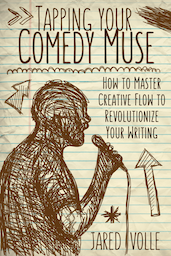
It’s like attempting to run a marathon and turning around every 15 seconds to see how well you’re doing. You can always analyze later, so stay in flow while you have it. Learn more about getting into a creative flow while writing and performing comedy with Tapping Your Comedy Muse. In the book, I share some of the best stand-up comedy tips for learning how to be a comedian who can write confidently. So if you want help coming up with funnier ideas for jokes, check it out.
Learn the Mechanics of Writing Stand-Up Comedy
There are many principles of writing and performing stand-up comedy. Stand-up comedy has been around a long time and the comedians that have gone before you have figured a thing or two out. Don’t try to build an entire career by trial-and-error.
Learn what works and what doesn’t early on and then apply those rules (but never be afraid to bend or break a few). It’s crazy how many comedians haven’t taken this part of their career seriously.
When you understand how to apply the principles of comedy, writing and performing don’t just get way easier… but you’ll also be way more effective as a writer.
Write Every Day
Don’t just write when you feel like it. Either have a set time to write every day or decide that, whatever happens, you’ll find time to spend at least 10 minutes writing… even if nothing great comes out of it. Writing every day gives you’re ideas time to develop between writing sessions.
When you get back to writing the next day, you’ll have more ideas to work with. It also makes existing material more interesting by allowing you to break free of a single perspective on your material.
Here are some great stand-up comedy writing exercises that are perfect for anyone learning how to be a comedian: They’re fun, informative, and (most importantly) help you write funny punchlines. These joke writing exercises go beyond stand-up comedy tips to both create funny punchlines while teaching you foundations of great comedy writing.
Allow Ideas to Evolve
Your best material isn’t going to be written the first time through. It’s often said that great comedy isn’t written… it’s “re-written.”
Usually, comedians will write a joke that gets the main idea of the joke across to the audience and test it out. From there, they repeatedly revise and test their joke out until they find the best way of writing and delivering a line. Many comedians do this 20, 30, or 50 times before settling on the final form of the joke.
Don’t Just Use One Writing Strategy
There’s a lot of comedy teachers that make writing comedy sound simple (i.e. “All you do is step one, two, and three… then repeat).
Problem is, if you use any kind of a system to write material the audience is going to figure it out REAL quick (good luck building a 45 minute set).
Instead, learn the principles behind those systems and ditch the system as quickly as possible.
Using the same strategy as everyone else will get you the same results as everyone else (stuck doing open mics for eternity).
If you had to bet between an amazing comedian using a system or an average comedian who understands the principles and has a strong POV… you should choose the average comedian… every time. (If you’ve read “Born Standing Up” by Steve Martin, you’ll understand how powerful this is).
Continually Switch Around Material to Create a Stronger, More Consistent Set
Each joke within your set doesn’t stand alone. Some jokes work best paired with others or further away from others.
Continually switch around the order of your jokes to find the right sequence. Usually, this means creating “bits.” Think of jokes as paragraphs in a book, bits as chapters, and your set as the whole book. Each bit has a common theme that makes it go well with other jokes. Continually restructure the order to find the best sequence.
MY (NOT) HILARIOUS MISTAKE : I have several closers I love doing, but my favorite “clean” closer is about hitting an elk with a car. By the end of the show, audiences understand I’m very silly and lighthearted, so the audience always goes with me. One night I tried a new closer, so I kicked my “elk closer” into the opener spot. It didn’t seem like an important decision, but the audience took it completely differently. Since they didn’t know I’m lighthearted yet, they weren’t sure if I was trying to use shock humor or not. Instead of getting massive applause breaks, like I was use to for the bit… I got an audience full of people thinking “Oh my God… he likes hitting animals with his car!” It took me several minutes of different material before I finally got the audience back on my side.
Don’t Worry About Spelling Or Grammar When Writing
Stand-up comedy is spoken, not written. The audience doesn’t care if you didn’t spell a word correctly cause they’ll never know. However, countless times comedians (I’ve been guilty of this as well) will think of a great joke, begin writing the setup line down, see that they didn’t spell something correctly, go back and change the spelling, and then… forget what the hell the joke was. Spelling can wait. A joke that isn’t captured on paper may never be seen again.
Never Steal Material
I know, this one’s obvious. But the consequences are too severe to leave it out. This will kill any relationships you have in the stand-up comedy community.
What’s scary here is that no comedian is going to come up to you and tell you they know you stole a joke… they’ll either quietly decide to never work with you or they’ll talk behind your back. Either way, you lose. It’s not worth killing on an open mic and burning bridges you’ll need later in your career.
Comedy Is About Self-Expression
Don’t sit down at your computer and try to “think up jokes.” You’ll be very frustrated when nothing good comes to you. Instead, use your writing time to express yourself. Talk about your frustrations, your ex-girlfriend… whatever. Comedy gets it’s power from the audience’s ability to identify with you and your material. When you don’t express yourself, you’re just saying words on a stage and the audience won’t be able to identify.
Don’t Require Perfection
If you require perfection when you write comedy, you’ll end up loathing your writing time. Until you get a joke on stage you’ll never know whether it’s funny or not.
Even famous comedians have to test out their material. If you’re doing a joke that’s new then, by its very definition, you don’t know what’s going to happen. Accept that perfection is impossible and instead strive for excellence.
STAND-UP COMEDY TIPS FOR PERFORMING ON STAGE
Learn how to be a comedian who can engage audiences and be memorable with these performance tips.
Don’t Memorize Every Word of Your Performance
If you memorize every word in your performance you’ll end up sounding like a robot on stage. Two things will happen. First, you’ll lose all the feeling in your material. You’ll know longer be authentic to the audience. Instead, the audience will feel like you’re talking AT them instead of TO them. You don’t naturally memorize words when you talk to your friends, you’re focused on the story you want to tell. When you’re learning how to be a comedian, it’s natural to want to have everything memorized. But remember, your natural voice doesn’t require knowing every word you’ll say. You simply focus on a topic and start talking.
Second, if you memorize word-for-word, you’re going to forget where you were at during a performance. The first thing that breaks your concentration will derail you and, since all you’ll remember are a string of words, you’ll be unable to remember which word you were on… the whole thing falls apart from there. Instead, memorize what you want to talk about (the subjects) and then simply talk about it. What you lose in “perfect word placement” you more than make up for in authenticity and relateability.
Focus on What You Want to Tell The Audience, Not On Yourself
When you focus on yourself, you get stage fright. When you focus on the audience you feel passion for what you’re saying. The brain is wired to think of only one thing at a time. When your focus is completely on the audience you’ll forget yourself and sink into the moment (termed “flow”). You’ll begin enjoying comedy more than you ever have. There’s no room for stage fright. Also, when you concentrate on the audience, the audience is going to feel it. They’ll sense your authenticity. When you care about them, they’re going to care about you.
MY OWN EXPERIENCE: I had a pretty crazy break-out. After several years of struggling, my “largest audience record” was around 250 people. After I rebelled against the old way of doing things I spent 3 months getting back to my old level of laughs… then I exploded. I went from thinking 250 was huge to doing an auditorium of 400. Several weeks later I was opened for Kyle Cease in front of over 1,100 people… then I performed in the finals of the Great American Comedy Festival for around 400… then back to working with Kyle in front of 1,000+. I use to get afraid of a show of any size, but when I started focusing on the telling the audience how I feel (and not on trying to be perfect on stage) then my stage fright vanished. In this video, I’ll share with you the best stand-up comedy tips for overcoming stage fright and anxiety.
Talk TO the Audience, Not AT Them
Break down the 4th wall. You’re not on television. You’re live. Talk to the audience as if they’re actually there. When you talk TO the audience you’ll come off far more authentic and the audience is going to respond to you more positively. When comedians launch directly into memorized material it signals to audience members that you’re just on stage “saying words.” There’s no connection there. The audience is going to stop paying attention. What’s worse… even if you DO get laughs, you’ll lack a connection with the audience and be quickly forgotten.
Perform Several Times a Week
The more time you spend on stage the more success you’ll have. Performing frequently allows you to test out the ideas you had while writing much faster. If you’re going to rewrite a joke 50 times before settling on the perfect one, you might want to perform more than once a week. Not only does it help you revise your material, but it helps you develop stage comfort as well.
Find a Home Venue
A home venue is a show or venue where you feel very comfortable performing. When you perform on new shows you never know what the audience is going to be like. Having a “home base” gives you a place where you can take chances, try new jokes out, or learn how to interact with audience members. This is where you’ll put in the hard work to learn how to be a comedian. After you’ve had a few good shows at that venue, you don’t really have anything left to prove to the audience or fellow comedians. You can relax and be more creative.
Create a Set List
A set list is a piece of paper that goes in your pocket (or sometimes on the stool) while you’re on stage that reminds you of what subjects you want to talk about. While certainly not necessary, for new comedians it is comforting to know that if you forget what you wanted to talk about that you have a back-up. Only write one or two words per subject on your set list. If you try to write the entire joke out you’ll end up reading the joke to the audience. Here’s an amazing trick for never forgetting material.
Just Because You Got a Laugh Doesn’t Mean Your Done
Getting a laugh doesn’t mean you have a finished joke. It means you have the basis for a joke. After a joke gets a laugh, your job is to figure out how to maximize the laughter for the next audience by revising the joke. Try taking out words that aren’t necessary or adding other words/phrases in. Test. Test. Test.
Learn to Use Pauses Effectively
Pauses are incredibly important if you want to perform stand-up comedy. They can often feel awkward for new comedians. One of the best stand-up comedy tips for new comedians is to practice pauses while rehearsing! That way you get pauses into your muscle memory and don’t need to think about it on stage. Check out this free comedy lesson on YouTube to learn more.
Balance Writing & Performing
Comedians are most effective when they balance their writing and performing time. Writing for 20 hours for every show you perform on is going to waste a lot of your time. You’ll find that ideas you spent a lot of time on aren’t what the audience wants to hear. Instead, spend time writing and get it on stage as soon as possible. That way you’re next writing session will be even better… which makes your next performance even better… and on and on.
Don’t Get Mad at the Audience
I get it. You spent a LONG time writing and practicing and now you show up to an open mic and there’s only 3 people sitting in the audience. Frustrating. You’ll probably encounter this many times while learning how to be a comedian. Open mics tend to be hit-or-miss. That’s the nature of the business.
That’s why comedians don’t put all their hopes and dreams on a single show. Many successful comedians hit 2-5 shows a night. They don’t get mad because there’s another show right around the corner.
When you get mad that the audience isn’t big enough you’re going to phone it in. When that happens, you might as well have stayed home. You’re not going to learn whether a joke actually works because you won’t tell it correctly. You’ll also miss the opportunity to practice on crowd work (a skill that will be HUGE later on in your career). Learn how to be a comedian who can engage audiences one-on-one. It works regardless of the audience size and is an important skill for the future.
Open Mics Are Your Training Ground. Use Them To Improve
Aspiring comedians tend to think that open mics are a place where everyone spends hours and hours before the show making sure everything is perfect. Not true in the least. Open mics are for learning your craft. That’s it. If the audience didn’t pay to see you perform than you don’t owe them anything. This might sound selfish, but it actually makes for a much better performance. Instead of doing the same jokes you’ll end up stretching yourself and possibly writing new material off-the-cuff.
Don’t Speak Formally
Throughout school you’ve been taught to write very formally. You were taught to write complete sentences, to use introductions and conclusions, etc. But that’s not how people communicate in everyday life. When you talk to a friend you’ll say only half a thought and pause. You’ll use informal words. You’ll gesture. This is what people are accustomed to when communicating verbally. When you get on stage and speak as if you’re on a school debate team it comes out awkward and inauthentic. Listen to how you and others around you naturally speak. Your performances should mimic it.
STAND-UP COMEDY TIPS FOR MARKETING YOURSELF
Here are 10 tips for learning how to make money as a comedian.
Get Good, Then Get Seen
Job #1 is to get to the point where you can consistently go out and get laughs on stage. If you’re hit-or-miss with your performances, you’re not ready to market yourself. Take the time to develop a solid set and get some stage time under your belt. Don’t burn bridges by performing on shows that are above your experience level. Bombing an open mic is no big deal. Bombing a show that people paid money to see (i.e. a showcase) is a big deal. You can be sure that that booker isn’t going to want anything to do with you again… even if you’ve gotten better since.
Be Remarkable
It doesn’t matter what medium you use to market yourself, if you’re not worth talking about you’re not going to get the YouTube views, the Twitter followers, or whatever. It goes back to “Get good. Then get seen.”
But being remarkable isn’t simply about having high enough quality material. Just because you get the audience to laugh doesn’t mean that they’re actually going to remember you long after the show or become a fan of yours. Remarkable is all about becoming “sticky” in the mind of the audience. The number one way of doing this is by being highly creative. Give them a reason to remember you. They’ll never remember that you were 5% funnier than the other comedians… but they’ll always remember you if you give them something new and interesting.
In short, don’t just focus on how to write jokes. Learn how to be a comedian who can give the audience something worth remembering.
Be Around the Scene, Not An Outsider
The more often you’re seen by other comedians the more comfortable their going to be around you. If you’re an “outsider” then they’ll likely balk at giving you a slot on their show. However, if they’ve seen you perform several times in the past and like your material, they’ll likely come to you when they have an opportunity.
Get Stage Time
Getting stage time is crucial to both writing and marketing. The opportunities you get in stand-up comedy will come from those you perform with. It’s what allows for networking and social media.
It’s also the fastest way to get funny. You can read stand-up comedy tips and write jokes all day, but nothing teaches comedy like a live audience. Every laugh shows you what to keep, and every silence shows you what to throw away. Comedy evolves in real time, and the audience is what shapes it. The more stage time you get, the faster your material sharpens and your comedic voice develops. Don’t guess what’s funny. Figure it out.
Network
Networking is the #1 marketing strategy in stand-up comedy. Every one of your paid gigs is going to be as a result of who you know. A fellow comedian will enjoy your set on an open mic and invite you to perform on a showcase or a paid gig. A recommendation can get you in the door of a comedy club much faster than the best promo video. Network with fellow comedians. Then use your network.
Use YouTube & TikTok Effectively
Don’t post every single show on YouTube. In fact, don’t even (publicly) post YouTube videos until you have a solid set. It’s fine to share them with friends and family privately. But remember, bookers will find you and do their research. If they want to book you for a big show and the first video they find of you is your very first performance you’re not going to book it. Only post what you’d be OK with a comedy booker or comedy producer seeing.
Use Social Media
Social media is your friend. Befriend every comedian in your city. Those comedians will often post which shows they’re performing on, giving you more ideas of what shows you can hit in the future. It also helps your offline networking. Instead of being a stranger you’ll be someone they’ve heard of… even if it was just online.
Be Professional
There are ghastly stories about hilarious comedians acting out. Each time the booker says the same thing “they were hilarious, but I can’t book them anymore.” It might surprise you, but bookers for professional venues (A-list venues) actually rank professionalism above humor. Comedy clubs can choose from any comedian they want… they can find someone just as funny to replace you if you’re not professional. A comedy club would much rather have a B-level comedian that’ll be at the show on time and treat their employees with respect than an A-lister that might forget to show up. Being professional means being on time, not being a jerk, and being easy to work with.
Start an Open Mic In Your Town to Get More Stage Time
Depending on what city you’re in there might not be many shows to perform on. If that’s the case, start your own show and book fellow comedians. Not only does having your own show help you network with other comedians (you now have something valuable that they want), but you also have a show you can control. You can choose to emcee the show, book yourself in an ideal spot, or take the night off… the choice is yours. You can even end up earning money.
Be Unique
If you want the audience to remember you after the show, give them a reason. The more unique you are as a comedian the more successful you’re going to be in the long-run. The comedians that obtain the ultimate success all have one common trait… they were unique. It’s held true since before comedy was even an industry and will be true long after stand-up comedy perishes. Audiences love uniqueness. Once you meet a minimum standard of quality, uniqueness becomes much more important to your success.
THE #1 KEY FOR A SUCCESSFUL COMEDY CAREER
STAND-UP COMEDY TIPS FOR SUCCESS
Here are the best 13 comedy tips for learning how to be a successful comedian.
Being Funny Is a Requirement In Comedy, Not an Advantage
As a comedy teacher, I’ve heard again and again about how “naturally funny” my students are. Here’s the cold hard fact… everyone in stand-up comedy is funny. That’s why they chose this industry in the first place. Nobody has ever said “I’m not funny at all. I’ll be a comedian.” It’s like assuming that you’ll be a successful entrepreneur because you have a business license. It’s a requirement to start. Sure, some people are funnier than others, but don’t rest on your natural sense of humor. Nurture it by studying comedy and applying what you’ve learned.
Learn Your Craft
Learn stand-up comedy inside and out. No matter what level you’re at, there’s always something to learn. The most successful comedians are those that don’t rest on their laurels. Search for every opportunity to learn more about what creates success in stand-up comedy. The stand-up comedy industry is an amazing one. You won’t find a job half this fun or interesting or one that is so easy to start and yet never gets old. How many comedians have you heard of that retired? They don’t. As they age, their material evolves with them. There’s always something new and interesting to explore.
Fail Fast
Becoming proficient at stand-up comedy requires some trial-and-error (though learning the principles of great comedy will cut A LOT of time off your learning curve). Learn these lessons as fast as possible by getting stage time. It makes no sense to perform once a month and expect your career to take off. Get on stage and try out new jokes. Try new delivery styles. Play with it. You never know what one simple idea might turn into. A bombed joke/bit isn’t a failure, but a bombed joke/bit that you spent months thinking about and worrying about is. Commit to learning your lessons fast so that you’ll make quicker gains on stage.
Don’t Move to a Major Market Too Early
You don’t have to be in Los Angeles or New York to be discovered (see “Get good. Then get seen”). Far too often new comedians will move to these cities in hopes that they’ll soon be discovered (very soon, cause rent is usually horrific). Instead, they find that there are TONS of comedians doing the same thing and it’s difficult to actually stand out. Hone your craft in your own city and move only when people keep asking you why you’re still staying.
Learn From People Who Are Where You Want to Be
The people that are ahead of you in this industry are there for one reason: they are doing something right. If you learn what it is, you can duplicate it in your own career and obtain similar success. Look at how these comedians write material, deliver it, and market themselves. These will provide invaluable insight into how to do it yourself. You’re not analyzing them to become a copycat. You’re analyzing them to learn key principles of success in comedy.
Look at the Big Picture
Comedy isn’t an industry that you can simply put your head down and expect to get promoted regularly. There’s no single path to stand-up comedy success. In a normal job you can show up to work for years and get promotions. Not so in comedy. To get ahead in stand-up comedy you’ll have to look at the big picture. If you get lost in details you’ll end up spending all your time writing joke after joke and never getting anywhere. Take time out and look at your current career trajectory.
Dirty Humor is Less Marketable
There’s nothing wrong with being a dirty comic. However, being dirty will limit your ability to book some venues. Some of the highest paid gigs in comedy are corporate gigs. And guess what, they don’t hire dirty comics. They want clean, family-friendly entertainment… and they’re willing to pay through the nose to get family-friendly. Keep this in mind when deciding whether to write 20 minutes about having drunken sex at the zoo.
Don’t Be a Look-A-Like
The world already has a Chris Rock and a Jerry Seinfeld. They don’t need another one. If you’re a look-a-like, the best you can hope for (even if you work REALLY hard) is to be seen as a wanna-be. That said, you gotta start somewhere. That somewhere is likely going to be similar to a comedian you love. That’s ok. Learn your lessons and then move forward into your own persona. You’ll go through 2 stages in your career: emulation and creation. You’ll begin by emulating comedians you love and testing out ideas… then you’ll find what works for you specifically and move into your creativity.
Don’t Get Caught Up In Learning Strategies: Focus On Yourself
Too often comedians want to know what action they should take to market themselves or how other comedians write their comedy. As if there’s simply one single action that can make all their problems go away. Are you under-utilizing YouTube for marketing? … Who cares! Cause that’s probably not the only thing stopping you from doing a set on the Tonight Show. You should find every strategy you can but at the same time realize that they’re all just strategies. Who’s doing the strategy is far more important.
Benchmark Comedians That Are Ahead of You
Look at the comedians that are where you want to be and begin comparing your career to theirs. Sure, this might create a little dissatisfaction at first, but it will pull you in the direction you want to go. Your job then becomes to simply close the gap by taking consistent actions. When you benchmark comedians that are killing it, you’ll no longer be satisfied with getting a couple of laughs on stage. You’re going to bring your game to a whole new level.
Work Ethic Applies to Comedy, Too
Seinfeld is one of the greatest comedians of all time because he has worked at it. He studied comedy more than anyone else. He got on stage more than anyone else. He spent more time writing than anyone else. How many “naturally funny” comedians do you think he blew right by in his career? A ton of them. Natural talent is good. Natural talent and work ethic is unstoppable.
Study the Masters
The great thing about the “masters” is how many videos you can find of them. Watch their comedy and analyze it. Break it apart and understand what they’re doing and how they’re doing it. Then apply those principles to your own comedy writing, performing, and marketing. This is what we do in the Faster & Funnier Comedian Breakdown Videos. Take 5-10 examples of perfect writing, performance, timing, POVs, openers, heckler takedowns, etc. and highlight exactly what skills they’re applying and why it’s so effective.
Mastery Begins Where You Are
Mastering stand-up comedy is about mastering the individual skills that go into quality writing and performances. Break down your large goals into sub-goals that you can practice and master. Begin by mastering lower-level skills, like various joke structures, and then move on to higher-level skills, like building rapport with the audience and using comedic storytelling techniques.
That’s it For These Free Stand-Up Comedy Tips
Learn how to be a comedian at your own pace online. Check out the Faster & Funnier Stand-Up Comedy Course. It will teach you everything you need to know about each type of joke, give you concrete steps to write each one, and then teach you exactly what to do to improve each joke. The course is broken into 5 separate levels so that you can focus on the mastering the most important skills at any give time.
Are you looking for the fastest way to learn how to be a comedian? Our online comedy classes give you step-by-step guidance on how to write stronger jokes, build unforgettable sets, and perform with confidence. If you’ve been looking for a clear path to becoming a funnier, more polished comedian, this is where it starts.
That’s it for these quick stand-up comedy tips. If you’re a new comedian, make sure you check out the free comedy training videos by signing up for our newsletter and get special bonuses.